Three checks, in order
Do them in this order, against the panel's neighbors:
- Is it reporting? Every microinverter has a row in the PVS6 device list with a
DATATIME, the last time the gateway heard from it. If that stopped while its neighbors' kept moving, it's a communication gap. Don't judge its health on missing data. - Is it low against its own roof face? Compare it with panels facing the same way, at the same hours. An east panel's peak is legitimately lower than a south panel's, so never compare across faces or against a fixed number.
- Where is the loss: DC or AC? Split power into volts and amps. The microinverter's whole job is turning the panel's DC into AC. If the DC arriving is low, the microinverter can't fix it.
What each pattern means
| What you see | Likely cause → what to do |
|---|---|
| Readings stopped updating; neighbors fine | Communication gap → wait a day; check its lifetime energy counter |
| Low output; volts normal, amps low | Light is missing (shade or dirt) → look for a new shadow; rain clears most dirt |
| Volts low all day, sun or shade | Panel side, e.g. a failed cell section → keep a week of readings; call an installer |
| DC normal, AC low | Microinverter underperforming → keep a week of readings; call an installer |
| DC present, AC zero, in full sun | Microinverter not converting → service call |
The fields to read
Each microinverter's row in the PVS6's dl_cgi/devices/list carries these. See reading the PVS6 device list to get them.
| Field | What it is |
|---|---|
| p_3phsum_kw | AC power out, kW |
| v_mppt1_v | DC volts from the panel |
| i_mppt1_a | DC amps from the panel |
| ltea_3phsum_kwh | Lifetime energy, kWh |
| t_htsnk_degc | Microinverter temperature, °C |
| DATATIME | When the gateway last heard from it |
What we've measured
Across 107 panels on four PVS6 systems, 1,313 panel-days from August 18 to September 2, 2026:
- No confirmed microinverter failures. Every loss we found was on the DC side.
- On one 22-panel roof, healthy panels peaked at 0.98 to 1.02 times their roof face's typical peak. Panels losing light sat at 0.23 to 0.80.
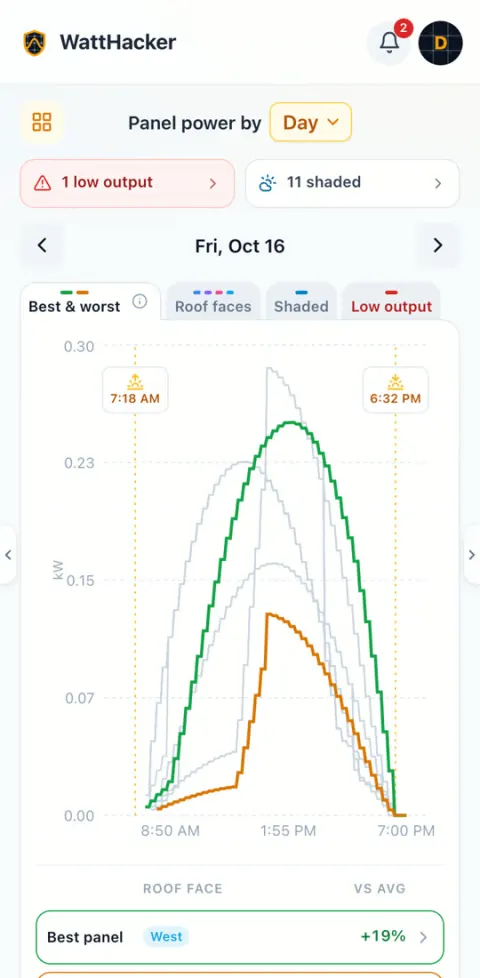
- A curve that looked like hardware wasn't. Four panels peaked at 9 AM and fell through midday. They held 41–42 V, as high as any healthy panel, while current fell from 4.3 A to 1.0 A. That's light being lost, not a fault.
- Conversion held near 96.5–96.9% of DC to AC on sunny hours, and didn't trend with temperature (95.4–97.0% from 40 to 65 °C). It only drops at very low power.
More on reading shade from the shape of a day: how to tell if a panel is shaded or broken.
Before you pay for a service call
- Keep a week of readings. One cloudy day proves nothing.
- Note the dates, and the panel's numbers next to its neighbors'.
- Don't climb the roof to look. A professional can, and rain clears most dirt.
- Check who covers it: is my SunPower warranty still worth anything?
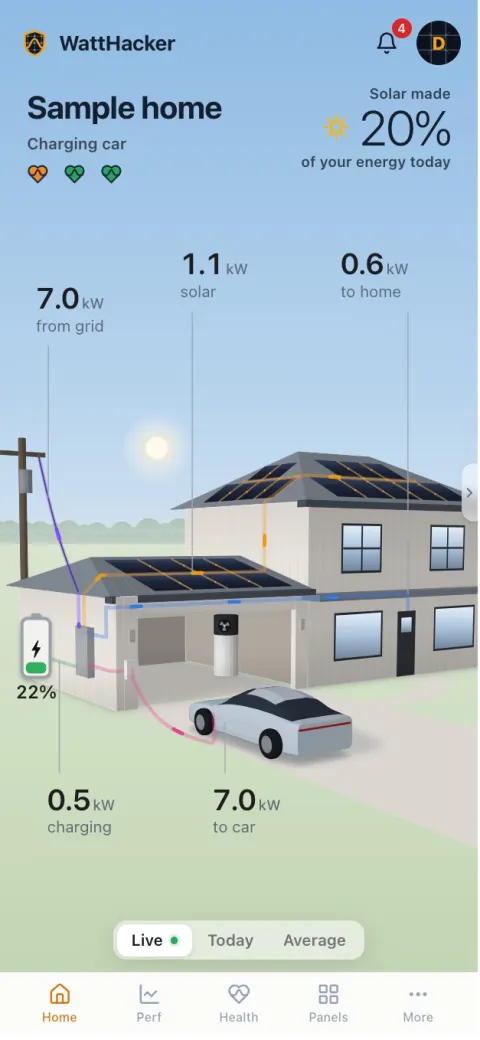
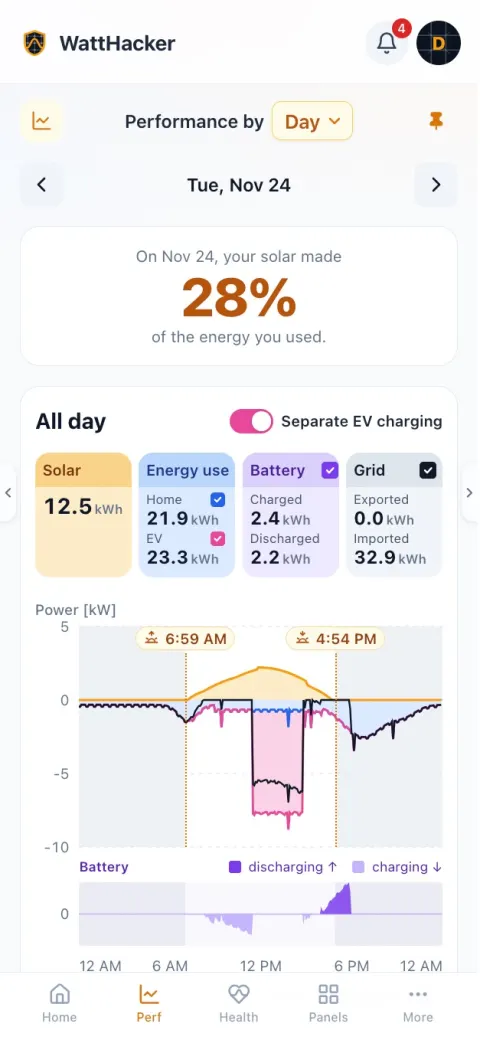
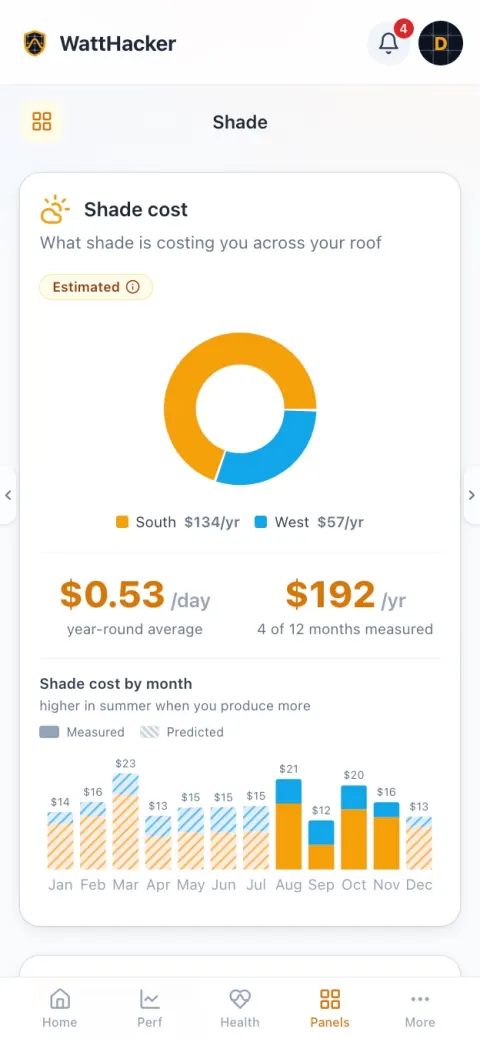
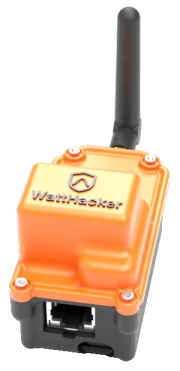
See every panel again.
- No subscription
- Alerts when a panel fails
- Plug it in yourself, no installer
$75 onceEvery panel, live
$199 oncePlus full history


Free app; monitor required. WattHacker is independent and not affiliated with SunPower, SunStrong, Maxeon, or Enphase.
Common questions
How do I know if my SunPower microinverter is bad?
Check three things against the panel's neighbors on the same roof face: is it still reporting, is its output in line with theirs over the same hours, and when it's low, are its DC volts normal? Normal volts with low amps means light is missing, from shade or dirt. Normal DC with low or zero AC output points at the microinverter.
One SunPower panel shows 0 watts. Is the microinverter dead?
Not necessarily. First check when the gateway last heard from it. If its readings stopped updating while its neighbors kept going, that's a communication gap and the panel may be producing fine. If it's current, in full sun, and its neighbors are producing, then 0 W is worth a service call.
Can I use the LED to check a SunPower microinverter?
Rarely in practice: the microinverter is bolted under the panel on the roof, and what each light means varies by model. The gateway's own readings are the better evidence, and you can read them from the ground.
How often do SunPower microinverters fail?
We can only speak to what we've measured. Across 107 panels on four PVS6 systems, 1,313 panel-days from August 18 to September 2, 2026, we found no confirmed microinverter failures. Every loss we found was on the panel's DC side, which usually means shade or dirt.
A panel only reports a few times a day. Is it failing?
No, that's a communication pattern, not a health verdict. Judge it on its lifetime energy counter against its neighbors over the same hours. Two such panels we checked made 1.005 and 1.009 times their neighbors' energy.
 See every panel again SunPower, no subscription.
See your own panels, live.
See plans Try the demo Back to home