Two numbers, two completely different jobs
Every panel reports a voltage and a current. Almost everything confusing about solar data comes from treating them as interchangeable. They are not.
Here is the whole model in one line; the rest of this page is the detail behind it:
- Current is light. How many photons are landing on the cells right now. Shade and dirt show up here.
- Voltage is how many cells are still connected. Mostly a property of the panel itself. It sags a little in dim light and more in heat, but it does not collapse unless the panel has actually lost something.
That distinction is worth more than it sounds. A panel losing output to shade, dirt, or a leaf looks completely different in the data from a panel that has physically failed.
And you can tell which is which without going on the roof.
Where the voltage comes from
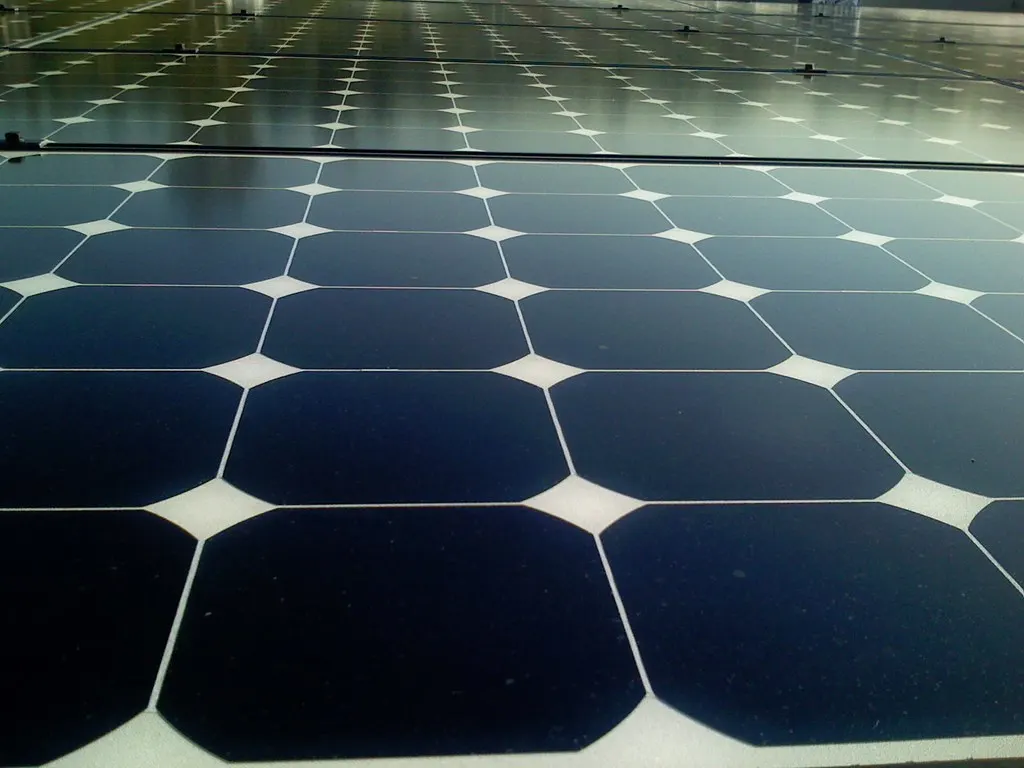
A silicon solar cell is a diode. Light knocks electrons loose and the cell develops a voltage across it, but only ever about 0.6 to 0.7 volts, no matter how big the cell is or how brightly the sun shines.
That number is set by the physics of the silicon. A cell the size of a dinner plate produces the same voltage as one the size of a stamp.
So to get a useful voltage you wire cells in series, and the voltages add up. A typical modern residential panel has 66 cells in series, which is where roughly forty volts comes from: 66 × 0.6.
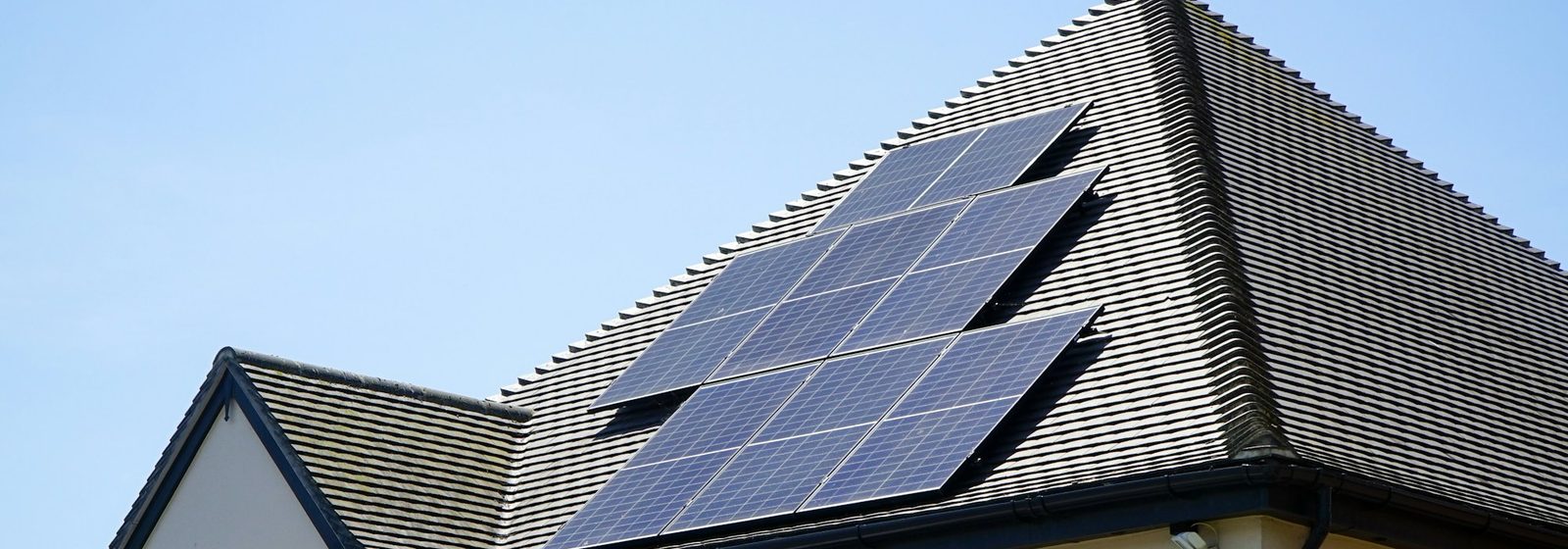
The panel's voltage is the sum of the active cells: the ones actually working and carrying current. While every cell is healthy, they all contribute and the total simply adds up.
That is why voltage is such a good report on the panel's physical condition. It is, quite literally, a count of how much of the panel is still in the circuit.
- Light moves it very little. Voltage rises with the logarithm of light intensity, not in proportion to it. Going from a dull morning to full noon sun might add a few percent.
- Heat moves it a lot. Panels lose roughly 0.29% of their power per °C above 25 °C, and most of that shows up as lost voltage. A panel at 60 °C on a still summer afternoon is meaningfully down on the same panel at 25 °C in April.
- Losing cells moves it in a step. If a cell cracks or an interconnect breaks, the panel's bypass diode conducts around that whole group of cells to keep the rest working. You lose that group's voltage, typically about a third of the panel, all at once.
Diagrams. The first is a healthy chain; the second is what a bypass diode does when one group fails: the panel keeps producing, at two-thirds of its voltage.
That last point is the one worth remembering. Voltage does not drift down as a panel ages badly; it drops in steps as chunks of it get bypassed.
Where the current comes from
Current is the opposite. It is set almost exactly in proportion to the light arriving: half the sunlight, half the amps.
It also scales with cell area, which is why a physically larger panel of the same technology makes more current at the same voltage.
So anything that blocks light shows up in the current: a cloud, a branch, dust, pollen, a bird, a leaf. The voltage does sag a little as the light drops, but it stays near normal. That asymmetry is the single most useful fact on this page.
Here is that playing out on a real panel: one healthy module on a customer roof, twelve days of readings, sorted by how much power it was making at the time. As power rises eighteen-fold, look at what each column does.
| DC power | Readings | Volts | Amps |
|---|---|---|---|
| 5 – 50 W | 856 | 34.0 | 0.56 |
| 100 – 150 W | 395 | 38.3 | 3.30 |
| 200 – 250 W | 335 | 36.4 | 6.20 |
| 300 – 350 W | 536 | 35.1 | 9.17 |
| 352 – 396 W | 66 | 36.6 | 10.22 |
Current goes up eighteen-fold. Voltage stays inside a seven percent band, and the dip in the middle of that band is the panel getting hot at high power, not dark.
Power is the two multiplied — and the microinverter chooses where
A panel does not have one output. It has a curve of possible operating points, and the operator picks one.
Draw no current and you get maximum voltage and zero power. Short it out and you get maximum current, zero volts, and zero power again. Somewhere between the two is a knee where volts × amps is largest.
Finding and holding that knee is the microinverter's first job, and it is called maximum power point tracking.
The knee moves constantly, with every cloud and every degree of temperature change. So the inverter hunts for it continuously, nudging its load on the panel and watching which way the power goes.
This is why the voltage in the table above sags at high power rather than rising. The tracker is not holding a fixed voltage; it is holding the best point, and on a hot panel at full sun that point has moved down.
Current is light. Voltage is how many cells are still connected.
The microinverter's four jobs
On a SunPower or Enphase system there is one of these bonded to the back of every panel. That is what makes per-panel data possible in the first place.
- Track the maximum power point of its own panel, independently of every other panel on the roof.
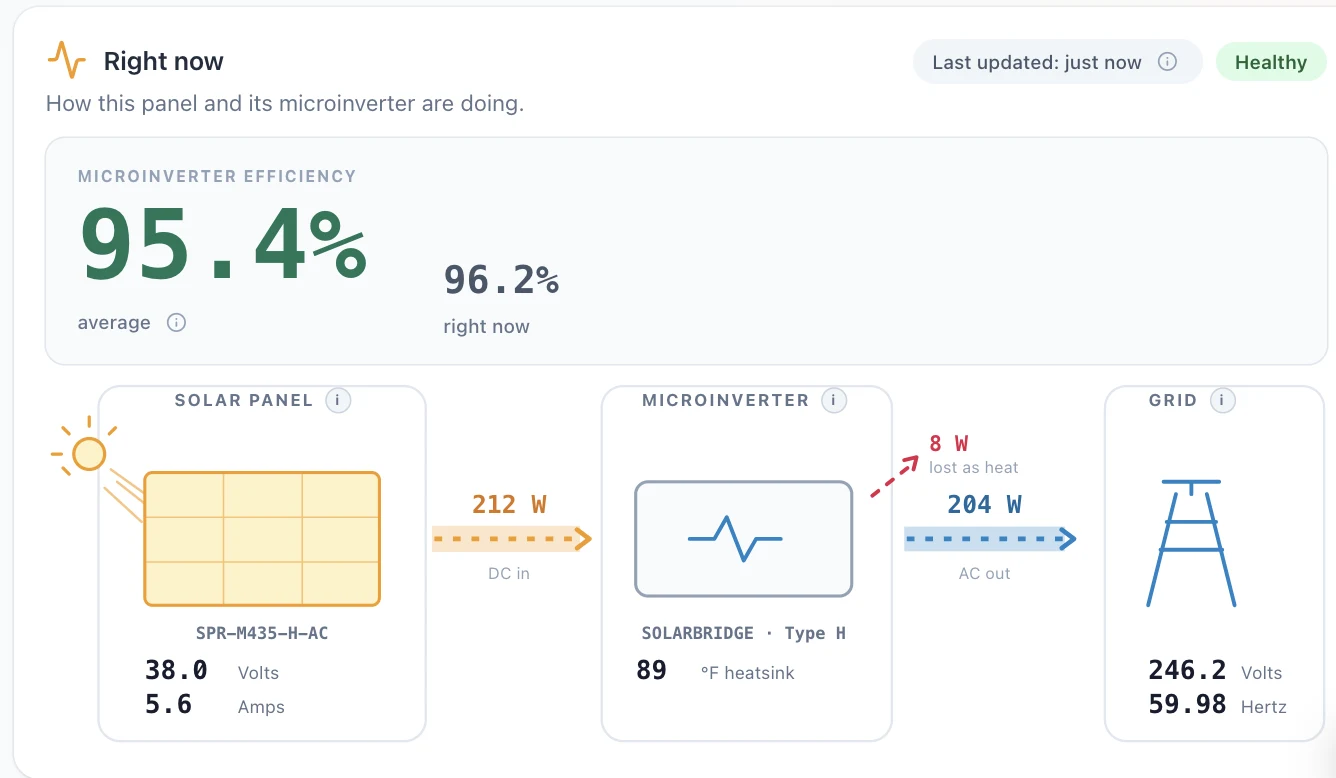
- Convert DC to AC at your home's voltage and frequency. This is where the conversion loss lives. A good modern unit is about 96 to 97 percent efficient once it has more than about 50 watts to work with, and that is the number we measure and compare across your roof. The chart below is that figure measured on 107 units.
- Synchronize with the grid. The AC it produces has to match the grid's frequency and phase closely enough that its power adds rather than fights. A grid-tied inverter is a follower: it needs the grid's waveform to lock onto.
- Disconnect when it must. Covered below, and it is the reason your solar does not run your house in a blackout.
The three times it deliberately makes less than it could
This surprises people, and it accounts for a lot of "why did my production flatten out?" questions. In all three cases nothing is broken: the inverter is doing exactly what it was designed and certified to do.
1. Clipping — the panel is bigger than the inverter
Microinverters are routinely paired with panels rated higher than they are, because a panel almost never reaches its nameplate. A common pairing on the systems we monitor is a 425 watt panel with a 384 watt AC microinverter.
On the few brightest hours of the year, the panel can produce more DC than the inverter is permitted to deliver. So the tracker deliberately moves off the maximum power point and holds output at the ceiling.
You can see this in real data. Across twelve days on one system, the highest AC output ever recorded from any panel was 384.3 watts, against a nameplate of 384. Not close to it. Exactly it.
Undersizing the inverter like this is a deliberate economic trade: the handful of clipped hours cost less than the bigger inverter would, every year, on every panel.
2. The grid asks it to back off
Modern inverters are required to respond to conditions on the grid itself, automatically and without telling anyone.
- Frequency-watt. Grid frequency rises above 60 Hz when more power is being generated than consumed. Inverters must reduce their real power output on a defined slope as frequency climbs, helping bring the grid back to balance. (It is over-frequency that triggers this. Under-frequency means the grid needs more power, which a panel already producing everything it can cannot supply; a battery can, and that is one of the things a battery is for.)
- Volt-watt. If the AC voltage on your street climbs too high, which is common on a sunny afternoon in a street full of solar, inverters reduce output to stop pushing it higher.
Both look like an unexplained midday or afternoon dip across every panel at once. That simultaneity is the tell: a fault hits one panel, a grid condition hits all of them.
3. It is too hot, or the grid has gone
Inverters derate when their own electronics get too hot, which on a roof in August is a real condition rather than a theoretical one.
And when the grid disappears, every grid-tied inverter must stop within about two seconds and stay off until the grid has been steady for several minutes.
This is anti-islanding. It exists so a rooftop array cannot energize a line that a utility worker believes is dead.
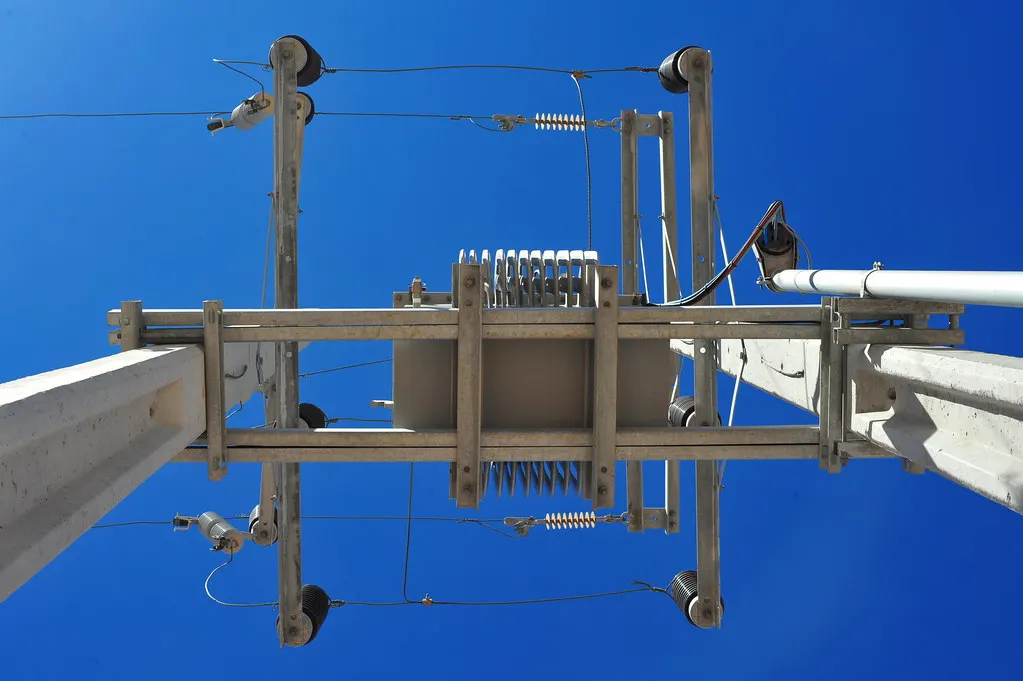
It is also the complete answer to "why doesn't my solar work in a power cut?" Running your house through an outage needs a battery and a transfer switch that physically separates you from the street.
Voltage does not drift down as a panel ages badly; it drops in steps as chunks of it get bypassed.
What this lets you work out about your own panels
Put the two halves together and you get a diagnosis that neither number gives you alone. This is the single most useful thing on this page:
- Current well down, voltage near normal → less light is reaching the panel. Shade, soiling, debris, a leaf. The panel and its electronics are fine.
- Voltage drops and stays down → part of the panel is electrically gone. A cracked cell, a broken interconnect, or a bypass diode stuck conducting. A shadow can switch a section out too, but only while it is on the panel, so the voltage comes back when the shadow moves. Down at every hour, day after day, is the panel; down for an hour or two is shade.
- Normal DC in, low AC out → the microinverter. The panel is collecting properly and the conversion is where it is being lost.
Notice that the middle case is the only one where hardware has actually failed.
You cannot reach any of these conclusions from a monthly kWh total, or even from a single day's production number. You need volts and amps, per panel, over enough days to be sure.
A caution, because it matters: this tells you which kind of problem you have, not what is causing it. A branch, a vent, bird mess, and a dirty patch are electrically identical.
Only a look at the roof settles that. But knowing whether to look at the roof at all, or to call someone about the electronics, is most of the value.
Where WattHacker fits
The WattHacker monitor is a small box that plugs into your existing SunPower PVS5 or PVS6 gateway on your own home network and reads it directly. It doesn't rely on SunPower's or SunStrong's servers, because for owners like you those are either gone or behind a paywall. No technician, no electrician, no rewiring — you plug it in yourself.
- The monitor is $50 once, with a 30-day money-back guarantee.
- Free to see your panel data, forever — every panel, live, no subscription, and no card on file.
- An optional premium plan at $6/mo (billed annually) adds the memory: full history kept for good, year-over-year comparison, and alerts told to you in dollars.
- Built by an electrification superfan who wants to help others use their solar smarter, lower their utility bills, and clean up the planet. Who's behind it.
Still have questions about your own system? I'll go through it with you — your panels, your bill, and what's worth doing about it.
Book an energy reviewAre your panels installed by SunPower or Enphase? See how it works for SunPower or Enphase, or see a demo.
Real panels, real production.
Common questions
What is the difference between DC voltage and DC current on a solar panel?
Current is set by light: roughly double the sunlight, roughly double the amps. Voltage is set by the panel's chemistry and how many cells are wired in series, and it barely moves with light at all — it changes logarithmically, plus a temperature term that pulls it down as the panel heats up. On a real 66-cell panel we measured over twelve days, an eighteen-fold change in power moved the current eighteen-fold and left the voltage inside a seven percent band.
What does a microinverter actually do?
Four things. It finds the point on the panel's curve where volts times amps is largest and holds the panel there, thousands of times a second. It converts that DC into AC at your home's voltage and frequency. It synchronises to the grid so its output adds to it rather than fighting it. And it disconnects within about two seconds if the grid goes down, so it cannot backfeed a line someone is working on.
Why does my panel produce less than its nameplate watts?
Usually because the microinverter is smaller than the panel on purpose. A 425 watt panel is commonly paired with a microinverter rated 384 watts AC, so on the brightest hour of the year the panel can make more DC than the inverter is allowed to deliver, and the extra is left on the roof. That is called clipping, it is designed in, and it costs far less over a year than the larger inverter would.
Can the grid tell my solar to produce less?
Yes, and modern inverters do it automatically. If grid frequency rises above normal — meaning more power is being generated than used — inverters are required to reduce their output on a defined slope. The same happens if grid voltage on your street climbs too high. Neither is a fault, and both look like an unexplained afternoon dip unless you know to look for them.
Why does my solar shut off during a power cut?
Because it is required to. A grid-tied microinverter has no idea whether the line is dead because of a storm or because someone is repairing it, so the rule is to stop within about two seconds and stay off until the grid has been stable for several minutes. Powering your house through an outage needs a battery and a transfer switch that physically separates you from the street.
Does one shaded panel drag down the others?
Not on a microinverter system. Each panel has its own inverter and its own maximum-power tracker, so a shaded panel loses its own output and nothing else. That independence is also what makes per-panel data worth reading: every panel is a controlled experiment against its neighbors.
See your own panels, live.
See plans Try the demo Back to home