Your water heater has a thermostat schedule
Most people set their water heater hot enough that they won't run out, then leave it at that one number all day and all night. There's a much better way. It buys cheaper electricity, uses less of it, and gives you as much hot water as the one-number setting, or more.
It works because a smart water heater can follow a temperature schedule, just like the thermostat on your furnace: several times a day, each with its own temperature.
Set it well and the tank becomes a battery. It stores energy when power is cheap and clean, and hands it back as hot water when power is expensive.
First, what a heat pump water heater is
A regular water heater makes heat, with an electric element or a gas flame. A heat pump water heater harvests heat that's already in the air around it.
It works like a refrigerator turned inside out. A fridge pulls heat out of the food and blows it into your kitchen. A heat pump water heater pulls heat out of the air (cooling it, like an air conditioner does) and puts that heat into the water instead.
Moving heat is far cheaper than making it. For every 1 kWh of electricity it uses, it puts about 4 kWh of heat into the water. Compared with a 100%-efficient electric element, that's about 75% less electricity for the same hot water. That's the number that makes everything below work.
The clever part: when to heat
If your utility charges more from 4 to 9 PM, the best time to heat is the early afternoon, then turn the heater down at 4. Three things line up then. The graphs below share one clock. Tap Play to add them one at a time.
Why those three hours
- Price. On PG&E E-TOU-C, power costs $0.29 per kWh until 4 PM and $0.32 from 4 to 9 PM in October. On the same plan in summer it's $0.32 versus $0.44. Every kWh moved out of the evening is cheaper.
- Warm air. A heat pump water heater pulls heat from the air around it. In this garage that air was about 60°F around sunrise and 82–91°F from 1 to 7 PM, so the same hot water takes a little less electricity in the afternoon.
- A clean grid. At 1 PM, California's grid carried about half the CO₂ per kWh it carried at 3 AM (California ISO data, Oct 3–6 2026). Midday is when solar floods the grid, your own panels included.
Where all three overlap is the sweet spot. You don't need solar for this. The price, the air, and the grid work the same for everyone. If you do have solar, it's also when your own panels are producing the most.
Why solar plus a heat pump is spectacular
A solar panel turns about 20–25% of the sunlight that hits it into electricity. The rest is reflected or lost as heat.
A heat pump water heater doesn't make heat from electricity. It moves heat out of the air into the water, at a COP (coefficient of performance) of about 3.8–4.2: roughly 4 units of heat for every unit of electricity.
Put them together and the heat pump earns back what the panel lost. Out of 100 units of sunlight, about 25 become electricity, and the heat pump turns those into about 100 units of hot water.
That's why the afternoon matters twice: your panels are producing the most, and the warm air gives the heat pump more heat to move.
Set it up: four settings a day
Rheem's EcoNet app lets you set four times a day, each with its own temperature. If your heater's app has a schedule, use it like this:
- Heat before the first shower. Turn it on about two hours before you wake up, just enough for morning showers.
- Turn it down when the first shower starts. The hot water is already in the tank, so it doesn't need to reheat on the coldest morning air.
- Boost in the afternoon. Turn it on at about 2 PM, set to about 125°F, so it's done by 4. This is where most of the day's heating should happen.
- Drop it at 4 PM and coast. A full, hot tank should carry you past 9 PM without the heater coming back on.
Tune it from what happened
- It came on between 4 and 9 PM? The tank ran short. Raise the afternoon temperature a few degrees.
- Still heating at 4 PM? The boost started too late. Move it earlier than 2 PM.
- Still heating when the first shower starts? Move the morning start earlier, say from 5:00 to 4:30 AM.
- Not hot enough, or still hot at the end of the last shower? Raise or lower the temperature a few degrees. Expect a couple of degrees warmer in winter and cooler in summer.
Give each change a few days. Showers, laundry, and guests move the numbers from one day to the next.
See it and control it in one place
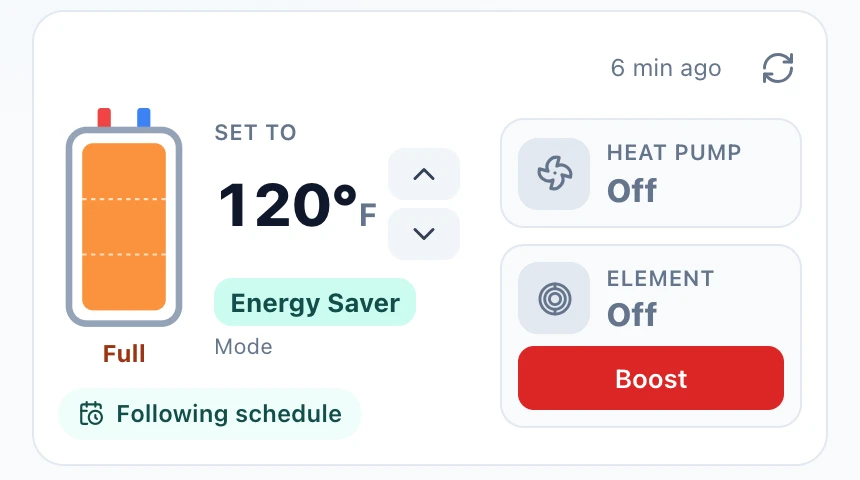
WattHacker shows your water heater beside your solar: whether it's heating right now, what it's set to, and the schedule it's following. You can raise the temperature or boost it from the same screen.
Why we call it a thermal battery
A home battery stores midday solar as electricity for the evening. A tank of hot water stores it as heat. It can't run your lights, but for the job it has, it works the same way: fill it when energy is cheap and clean, use it when energy is expensive and dirty. If you have a tank water heater, you already own one.
Smarter water heating, on the same screen as your solar
The WattHacker app connects to Rheem EcoNet heat pump water heaters (A.O. Smith and GE are in early pilot). It shows when yours is heating, what it's set to, and the schedule it's following, and it lets you change the temperature or boost it. With the WattHacker monitor on your solar, you can see whether your hot water is being made from your own sunshine.
- No extra hardware for the water heater. You sign in with the account you already use for your heater's app.
- The WattHacker monitor reads your SunPower or Enphase solar directly, so heating time and solar production sit on the same clock.
- Built by someone who heats his own water this way.
Still have questions about your own system? I'll go through it with you — your panels, your bill, and what's worth doing about it.
Book an energy reviewAre your panels installed by SunPower or Enphase? See how it works for SunPower or Enphase, or see a demo.
Real panels, real production.
Common questions
What time of day should a heat pump water heater run?
Mostly between about 1 and 4 PM, if you're on a time-of-use plan with an evening peak. That's when three things line up: power is cheaper than during the 4 to 9 PM peak, the air the heat pump draws from is warmest, and California's grid carries the least CO₂ per kWh. A full tank then carries you through the evening.
What does WattHacker's founder do?
He runs the water heater in the morning just long enough to keep morning showers hot, then does the bulk of the heating from about 2 to 4 PM. In the data on this page, that's the cleanest and most efficient time of day to heat water.
Do I need solar panels for this?
No. The cheaper afternoon rate, the warmer air, and the cleaner grid are there whether or not you have solar. With solar, it's even better: the heating happens while your own panels are producing the most.
Why does warm air matter to a heat pump water heater?
A heat pump moves heat out of the air around it into the water. It's a little more efficient pulling heat from 90°F air than from 60°F air, so it gets slightly more heat for the same electricity (a higher COP). In the garage on this page the air ran from about 60°F around sunrise to about 91°F at 4 PM.
Is a water heater really a battery?
A tank water heater can be. It stores energy you put in earlier and gives it back as hot showers later, so you choose when to heat. A tankless (instant) water heater can't: it heats only while the water is running, so the heating always happens at the same moment you use it. Tankless heaters are also under 100% efficient, while a heat pump water heater delivers roughly 380% to 420%: about 4 units of heat for every unit of electricity.
How do I set my water heater's schedule to be efficient?
Morning: turn it on about two hours before you wake up. Before your first shower, check whether it's still heating (the WattHacker app shows this). If it's off, it reached its target temperature. If it's still on, move the start earlier, for example from 5:00 to 4:30 AM. If the water isn't hot enough, raise the temperature. If the end of the last morning shower is still hot, lower it and save energy. Afternoon: turn it on at about 2 PM, set to about 125°F, and check that it's done heating by 4 PM. If it isn't, start earlier than 2 PM. If it has to come back on before 9 PM, raise the temperature. Seasons: you'll likely want a couple of degrees warmer in winter and a couple cooler in summer.
See your own panels, live.
See plans Try the demo Back to home