
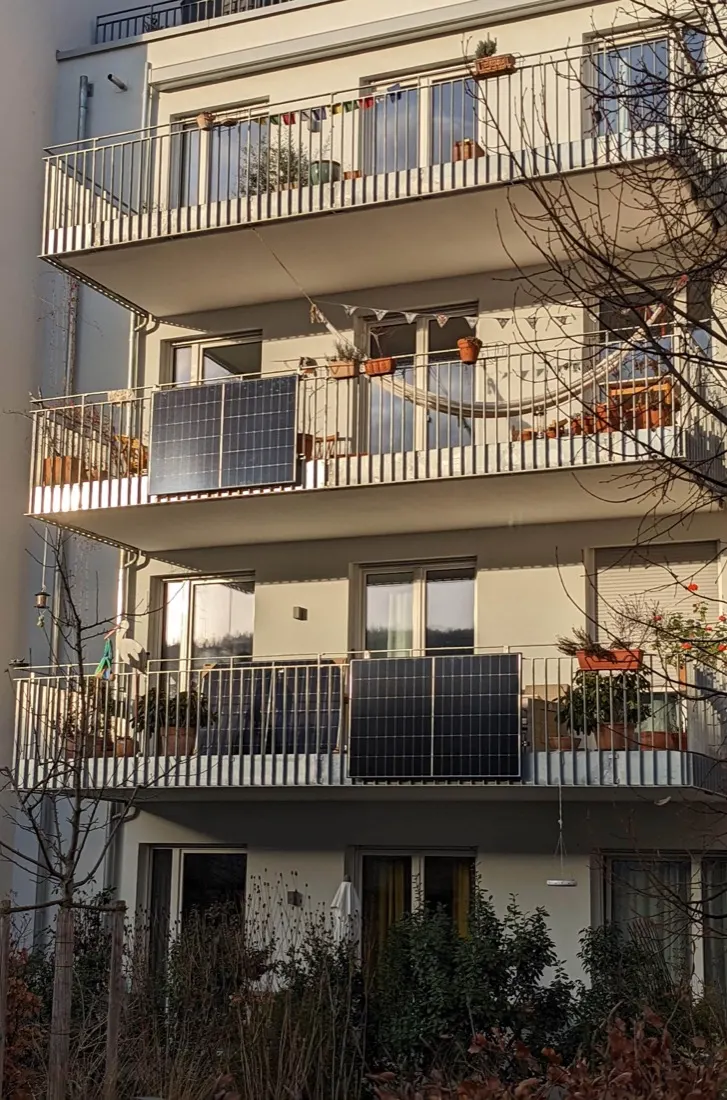
In Germany, solar panels plugged into a wall outlet are a common sight on apartment balconies. In most of the U.S., the same kit is a gray area at best.
That's changing fast. Utah passed the first plug-in solar law in 2025. In 2026, lawmakers in dozens of states filed bills, and nine more states signed one.
Most follow Utah's model: a cap of about 1,200 watts, no utility approval, no utility fees, and no net metering.
The states with a law
As of October 15, 2026. Each allows up to 1,200 W per home, except Colorado, which allows 1,920 W.
| State | Starts | Utility |
|---|---|---|
| Utah | Now | No approval |
| Maine* | Now | Notice over 420 W |
| Vermont | Now | No approval |
| Maryland | Now | Notice first |
| Connecticut | Now | Ask your utility |
| Colorado | Aug 2026 or Jan 2027† | No pre-approval |
| Virginia | Jan 1, 2027 | Notice first |
| New Hampshire | Jan 1, 2027 | No approval |
| California | Jan 1, 2027 | May ask you to register |
| New Jersey | Mar 1, 2027 | No approval |
* Maine: up to 420 W you can install yourself. From 420 W to 1,200 W you need a licensed electrician and a dedicated circuit.
† Colorado's law was signed May 7, 2026. Published sources disagree on when it takes effect.
New York passed the SUNNY Act in May 2026. It allows 1,200 W, with a utility notice within 30 days. In October it was still waiting for Governor Hochul's signature. Massachusetts has plug-in solar in an energy bill still being negotiated.
California's law has its own page: what SB 868 allows.
Most follow Utah's model: about 1,200 watts, no utility approval, no utility fees, and no net metering.
Permits and permission to operate
Rooftop solar needs two sign-offs: a building permit from your city, and permission to operate (PTO) from your utility. A plug-in law is mostly about the second.
- The utility. Every state law above bars utilities from requiring approval for a qualifying kit, and from charging fees for it. Some ask for a notice or a simple registration instead. That's not asking permission.
- Building permits. It varies. New Jersey bars towns from requiring one. Vermont bars town bylaws from regulating kits. Virginia bars localities from prohibiting them. California's law doesn't mention permits; ask your building department.
- Landlords and HOAs. It varies. New Jersey asks tenants and HOA members to give their landlord or HOA 14 days' notice. California's law says nothing about either. Ask before you hang anything on a railing you don't own.
In a state without a law
Plug-in kits are sold everywhere. Using one is another matter.
A kit's inverter feeds power into your home's wiring while it's connected to the grid. Utility rules treat that as a generator, and generally require an application and written permission first. California's rule, for example, requires the utility's "express written permission before Parallel Operation."
The electrical code doesn't help either. According to UL, "The 2026 NEC, like all previous editions, does not recognize the use of plug-in photovoltaic (PIPV) modules."
Many people plug kits in anyway. That doesn't make it allowed, and your utility could ask you to disconnect.
The certification catch
Most of the new laws protect only a certified kit. California, Vermont, and New York's bill ask for certification to UL 3700, a framework UL launched in January 2026, or an equivalent.
By October 2026 a few products had announced certifications, mostly for inverters rather than whole kits. A law that protects only certified kits doesn't help much until they're on sale.
Before you buy, ask for the certificate, and check that it covers the whole kit. Why the outlet and breaker matter.
If you already have rooftop solar
Every one of these laws was written for homes without solar. If you have panels on your roof, they raise a different question: what a kit does to your net metering. In Vermont the answer is simple. A home with net-metered solar may not add a plug-in kit at all.
The bottom line
In a plug-in-law state, a certified kit needs no utility approval. Everywhere else, it's treated like any other solar system.
Already have solar on the roof?
Before you buy a plug-in kit, find out whether your house is already sending power to the grid at midday. If it is, a plug-in kit mostly adds to that export instead of cutting your bill. The WattHacker monitor shows your rooftop production live, panel by panel. It plugs into the SunPower or Enphase gateway you already own.
- Home use is shown too where your system was installed with consumption meters. Without them you see production only. Your utility's hourly usage download also shows export.
- A plug-in kit is a separate inverter. Your rooftop gateway will not count its production, so neither will we.
- Free to see your panel data, with no subscription. The monitor is a one-time purchase with a 30-day money-back guarantee.
Still have questions about your own system? I'll go through it with you — your panels, your bill, and what's worth doing about it.
Book an energy reviewAre your panels installed by SunPower or Enphase? See how it works for SunPower or Enphase, or see a demo.
Real panels, real production.
Common questions
Which states allow balcony solar?
As of October 15, 2026, ten states have signed plug-in solar laws: Utah (2025), and in 2026 Maine, Virginia, Colorado, Maryland, Connecticut, Vermont, New Hampshire, New Jersey, and California. Several don't take effect until 2027. New York's SUNNY Act passed the legislature in May 2026 and was still waiting for the governor's signature in October.
Do I need a permit for balcony solar?
In a state with a plug-in law, usually not from your utility: the laws bar utilities from requiring approval or fees for a qualifying kit. Building permits vary. New Jersey bars towns from requiring one, Vermont bars town bylaws from regulating kits, and Virginia bars localities from prohibiting them. California's law doesn't mention them. In a state without a law, a plug-in kit falls under the same rules as rooftop solar.
Do I need permission to operate (PTO) for plug-in solar?
Not in a state with a plug-in law, for a kit that qualifies. Some states ask you to notify the utility instead: Virginia and Maryland before you install, Maine within 30 days for kits over 420 W, and California may require a simple online registration. In a state without a law, utility rules generally require an interconnection agreement and permission before any generator runs connected to the grid.
What is the wattage limit for balcony solar in the U.S.?
Most state laws allow up to 1,200 watts of inverter output per home. Colorado allows up to 1,920 W. Maine lets you install up to 420 W yourself; above that, up to 1,200 W, needs a licensed electrician and a dedicated circuit.
Is balcony solar legal in states without a plug-in law?
Not as a plug-in system. The 2026 National Electrical Code, like every edition before it, does not recognize plug-in solar modules, according to UL. And a solar inverter feeding your home's wiring counts as a generator connected to the grid, which utilities generally require you to apply for. Many people use kits anyway; that doesn't make it permitted.
Do plug-in solar kits need UL certification?
Most of the new laws require it. California, Vermont, and New York's bill call for certification to UL 3700, the new framework for plug-in solar, or an equivalent. UL began certifying under it in January 2026. Some parts, such as inverters, have certifications. Few complete kits had cleared it by October 2026, so check the certificate covers the whole kit.
See your own panels, live.
See plans Try the demo Back to home