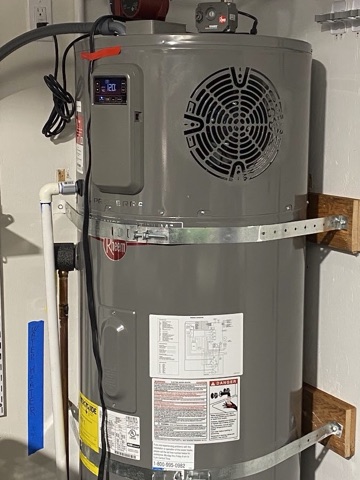
Every degree you keep a tank of water hot costs you twice. First, the heater has to make that heat. Then the tank loses that heat to your garage or basement around the clock, whether anyone uses hot water or not.
That's why the U.S. Department of Energy recommends setting water heaters to 120°F. At 140°F, it estimates a tank loses $36 to $61 a year in standby heat alone, and lowering it saves 4% to 22% on water heating.
Why not just turn it up?
It's a fair question. A hotter tank holds more hot water. You mix hot with cold at the shower, so a tank of 140°F water stretches further than a tank of 120°F water.
Same 50-gallon tank, more showers
So a hotter tank is a bigger battery. But it's costlier to fill, and it loses heat faster while it waits. Every shower needs the same amount of heat, whatever the tank is set to. What changes is how much electricity it takes to make that heat.
Electricity to heat one shower
And a hotter tank loses heat faster while it waits. We measured it:
A hotter tank loses heat faster
Turning it up buys more hot water, at a worse price, around the clock.
So the efficient way to run a heat pump water heater is to keep it cool, and make it hot only when you need the extra. That's exactly where the skeptics come in.
“Don't heat pumps grow Legionella?”
Legionella is the bacterium behind Legionnaires' disease, a serious pneumonia people catch by breathing in mist from contaminated water, as in a shower. Because heat pumps are often run cooler, you'll hear that they're a breeding ground.
A 2025 scientific review went looking for that evidence. It found none.
The review, published in Microorganisms, says no research it covered has shown a link between water from heat pump water heaters and Legionella disease. It also found that no study had actually measured colonization inside them. The authors don't call heat pumps risk-free; they say they can't be ruled out either.
The older evidence points somewhere else entirely: at temperature, not at the heat pump. In a 1991 study of 211 homes near Quebec City, Legionella turned up in 39% of ordinary electric water heaters, the kind with heating elements, and in none of the oil or gas ones. Heat pump water heaters weren't even on the market.
Where Legionella was found, 1991
The risk isn't which machine heats the water. It's how warm the water sits, and where.
How Legionella lives
Legionella is everywhere in fresh water in tiny numbers. It only becomes a problem when it finds a place to multiply, and a water heater can offer three things it loves.
What Legionella needs
That bottom layer is the weak spot. Cold water comes in at the base of the tank, and the UK's safety regulator warns that the cool layer it forms there favors bacterial growth. In an electric tank, the Quebec researchers wrote, the bottom typically sits around 86°F to 104°F, right in Legionella's range, while the water at the top is hot.
How it dies
Heat kills Legionella, but not instantly. It dies off along a curve, and a few degrees make a big difference.
Time to kill 90% of Legionella
A lab flask heats evenly; a real tank doesn't. Bacteria shelter in slime and in the cool bottom. That's one reason makers hold 140°F for a full hour, not two minutes. And it's why buildings are told to store hot water at 140°F all the time. For a home, that's the expensive, inefficient answer, and it raises the scald risk at every tap.
The clever way around it
You don't need a hot tank. You need a hot hour.
Heat pump water heaters in Europe have done this for years. The tank runs cool and efficient day to day, and every so often it heats all the way to 140°F and holds there long enough to clear itself. The 2025 review describes exactly this as the most common approach: keep the water warm, and boost it periodically to 140°F, holding it for 15 minutes to an hour. A study for the UK government found that low everyday temperatures plus periodic sterilization were the most efficient combination.
The trick is when you do it.
It depends on one part: a mixing valve at the heater, which blends in cold water so the taps never run scalding.
- With a mixing valve: early afternoon. Heat to 140°F between about 1 and 3 PM and hold it an hour. Off-peak power, the warmest air, and a tank the day's preheat already warmed.
- Without one: late Sunday night. Heat to 140°F after the evening peak and hold it until about 2 AM. The heat goes into Monday's showers, and the tank has cooled by morning, so the taps are less likely to scald.
How often? No U.S. rule sets a frequency for homes. UK heat pump maker Grant recommends 140°F for an hour every week or every two weeks for most homes, and more often where someone is vulnerable. Mixergy's smart tanks run their cycle at least every two weeks. Weekly is the safe middle: often enough that the tank never has long to recover, rare enough that it barely shows up on the bill.
One caution: 140°F water can scald in seconds. A mixing valve at the heater lets the tank run hot while the taps stay safe. And a hot tank doesn't clean the pipes beyond it.
Sources
- U.S. Department of Energy: lower your water heating temperature
- California Energy Commission / Ecotope: heat pump water heater load shifting (COP 2.8 at 125°F, 1.8 at 155°F)
- WattHacker measurement: a monitored air-to-water heat pump, 707 steady-state readings, Oct 11–21, 2026. COP = 6.09 − 0.035 × (water − air temperature, °F), R² 0.86.
- NEEA: plug-in heat pump water heaters (3–8% at 140°F vs 125°F)
- Brookes et al. (2025), Legionella in Hot Water Heat Pump Systems, Microorganisms
- Alary & Joly (1991), Applied and Environmental Microbiology (69 of 178 electric tanks)
- CDC: monitoring building water
- CDC: Legionella Environmental Assessment Form (dormant below 68°F)
- World Health Organization (2007): Legionella and the prevention of legionellosis, §2.2.1
- Lévesque, Lavoie & Joly (2004), Canadian Journal of Infectious Diseases
- UK Health and Safety Executive: HSG274 Part 2, ¶2.25–2.28
- Grant Aerona R32 heat pump addendum, Table 5-2
- Mixergy: cleansing cycle
- National Academies: Management of Legionella in Water Systems
- UK government: hot water cylinders and heat pumps
WattHacker does all of this for you, automatically
Connect your Rheem heat pump water heater through EcoNet once, and Smart water temperature runs it for you. Nothing to set or remember. How the thermal battery works · Set it up
- Cool and efficient every day.
- One hot hour a week at 140°F: early afternoon with a mixing valve, or late Sunday night without one (with your OK).
- A thermal battery: it heats on cheaper power before your utility's evening peak and coasts through it.
- No WattHacker monitor needed, just the account you already use for your heater's app.
Still have questions about your own system? I'll go through it with you — your panels, your bill, and what's worth doing about it.
Book a free callAre your panels installed by SunPower or Enphase? See how it works for SunPower or Enphase, or see a demo.
Real panels, real production.
Common questions
Do heat pump water heaters grow Legionella?
There's no evidence they do. A 2025 scientific review in Microorganisms found no research linking water from heat pump water heaters to Legionella disease, and no study that had measured colonization inside them. The authors say the risk can't be ruled out either. What the older evidence points to is temperature: how warm the water sits, and where in the tank.
What temperature kills Legionella in a water heater?
Heat kills it along a curve. In lab tests reported by the World Health Organization, killing 90% takes 80 to 124 minutes at 122°F, about 2 minutes at 140°F, and is almost instant above 158°F. A real tank heats unevenly, so heat pump makers hold 140°F for an hour.
Should I set my water heater to 140°F all the time?
For a home, that's the expensive answer. At 140°F the Department of Energy estimates $36 to $61 a year in standby losses alone, a heat pump makes each shower's heat about 30% less efficiently, and the scald risk rises at every tap. A cool tank with one hot hour a week gets the protection for far less.
How often should a water heater run a Legionella cycle?
No U.S. rule sets a frequency for homes. UK heat pump maker Grant recommends 140°F for an hour every week or every two weeks for most homes, and more often for vulnerable households. Weekly is a safe middle.
Can WattHacker run the hot hour for me?
Yes, on a Rheem heat pump water heater connected through EcoNet. Smart water temperature keeps the tank cool day to day and preheats on off-peak power before your utility's evening peak. Once a week it heats to 140°F and holds it for an hour: in the early afternoon if you have a mixing valve, or late Sunday night if you don't (with your OK to heat above 120°F).
See your own panels, live.
See plans Try the demo Back to home