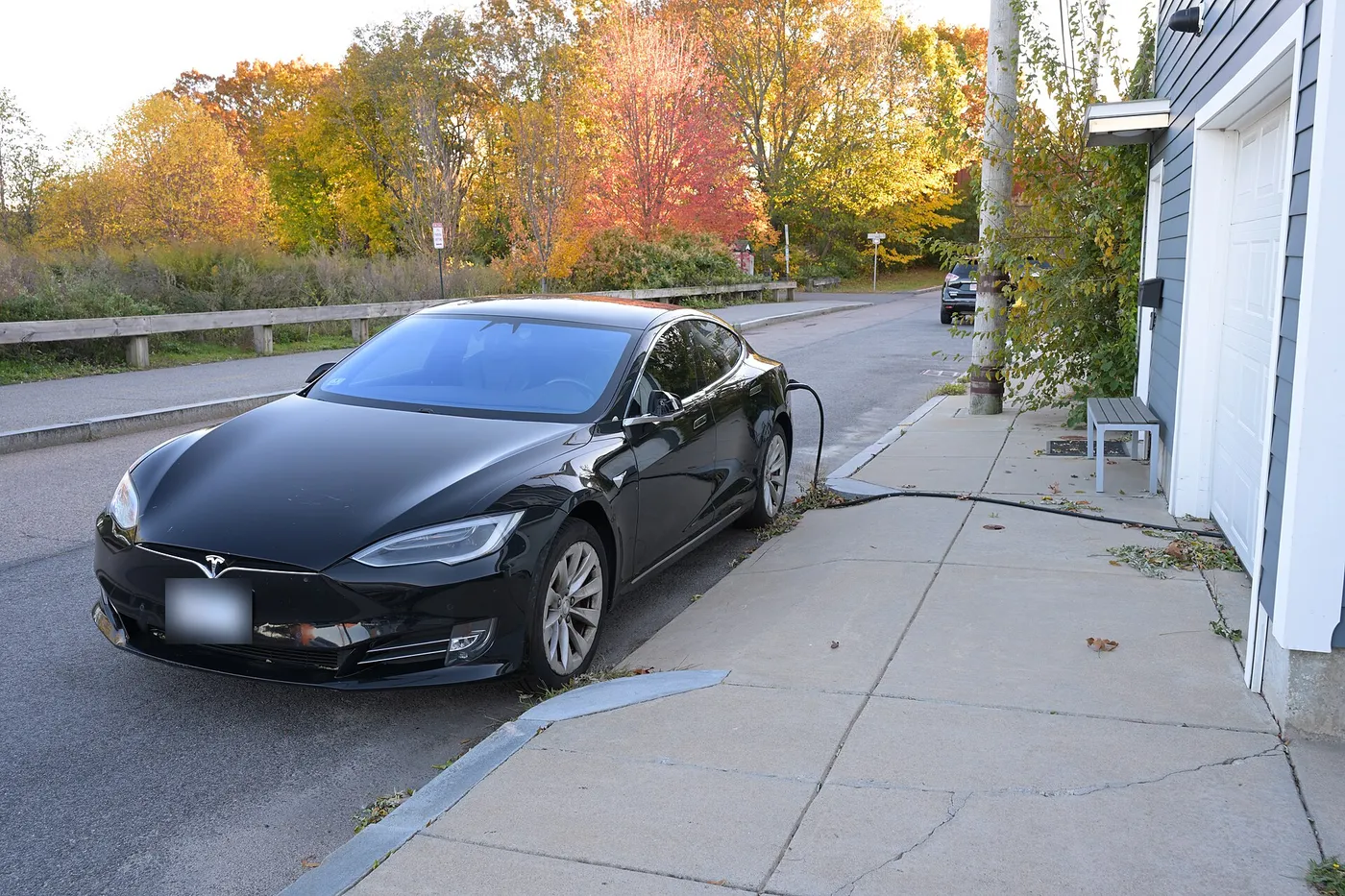
Most EV owners plug in when they get home and let the car charge overnight. The house is quiet, and power is cheap.
But California's grid swings hard every day. At midday, solar runs it. After sunset, batteries carry the evening. By 2 AM they're spent, and gas plants carry the night.
One day on the grid
The week we checked, gas plants ran about 4.6 GW at midday and 9 to 10 GW from 4 PM through the night: about double. Batteries soaked up solar at midday, gave it back from 4 PM to midnight, and were nearly empty by 2 AM.
Here's what that does to the CO₂ in each kWh, and what three EV rate plans charge, on one clock.
At 1 PM, a kWh carried about a third of the CO₂ of a kWh at 3 AM.
That's the grid's average, from the California ISO's own data. Every day that week, night was 1.8 to 3.4 times dirtier than midday.
And noon costs no more. On all three plans, 10 AM to 2 PM sits at the lowest price. The expensive hours start at 4 PM.
Charging at midnight means about 2½ times the CO₂ of charging at noon.
With newer solar, it's not close
If you applied for solar on or after April 15, 2023, you're likely on California's Net Billing Tariff. PG&E calls it the Solar Billing Plan.
Power you send to the grid earns a credit that changes by the hour. At midday, when every roof is producing, it's small.
So every kWh that goes from your roof into your car at noon is one you didn't sell for about 6¢, then buy back at night for about 28¢.
In April, PG&E's noon credit drops to about 1¢ or less.
Who this doesn't fit
- The car is gone all day. No charger at work? Charge at night, and set it to start after midnight. On PG&E's EV2-A, 9 PM to midnight costs about 39¢ in winter; after midnight, about 23¢.
- Older solar. Applied before April 15, 2023? You're probably on NEM 1 or NEM 2, with exports credited at retail rates. Timing matters far less to your bill. The CO₂ gap is the same.
- Outside California. This is California's grid and its rates. Yours may differ.
The bottom line
If your car can be plugged in at midday, charge it then. If it can't, wait until after midnight.
Got SunPower or Enphase panels?
WattHacker's monitor tracks not only your panel-level performance, but also your EV charging, battery, and even water heater.
- Works today with Emporia and Tesla Wall Connector chargers, a Tesla Powerwall, and Rheem heat pump water heaters.
- The live view is free. Gigawatt keeps the history: $199 once, monitor and shipping included, backed by a 30-day money-back guarantee.
Common questions
Is it better to charge an EV at night or during the day?
In California, midday is usually better if the car can be plugged in then. On the California ISO grid, a kWh at 1 PM carried about a third of the CO₂ of a kWh at 3 AM (Nov 8–14, 2026). PG&E's EV2-A, SCE's TOU-D-PRIME, and SDG&E's EV-TOU-5 all price 10 AM to 2 PM at their lowest rate.
What is the cheapest time to charge on PG&E EV2-A?
Midnight to 3 PM, every day: about 23¢ per kWh for PG&E bundled service, summer and winter (effective June 1, 2026). Peak is 4 to 9 PM. 3 to 4 PM and 9 PM to midnight are part-peak, about 39¢ in winter.
Should I charge my EV from solar under NEM 3?
If you can, yes. On PG&E's Solar Billing Plan (the Net Billing Tariff, or NEM 3), a kWh sent to the grid at noon on a November weekday earns about 6¢. A kWh bought back at 1 AM on E-ELEC costs about 28¢ in winter.
Does this matter if I'm on NEM 2?
Less, for your bill. Under NEM 1 and NEM 2, the CPUC says export credits are applied at retail rates, so selling at noon and buying back at night is close to even. The grid's CO₂ is still lower at midday.
 See every panel again For SunPower and Enphase solar.
See your own panels, live.
See plans Try the demo Back to home